


Insects you might see on a Kruger National Park safari include honeybees and the praying mantis, and you may also come across spiders such as the golden orb web spider and the common rain spider. Some of Africa’s insects are potentially dangerous, but there is no need to be scared: if you do not aggravate them, they will not do you any harm.
The Kruger National Park is full of life, but these are some insects and spiders you might see on your safari.
Golden Orb Web Spider
A part of the Nephila family of arachnids is the banded-legged nephila, commonly known as the golden orb spider. Around the world, there are several nephila species, also referred to as golden orb-weavers, giant wood spiders, or banana spiders.
The name of the genus, loosely translated from Ancient Greek, means “fond of spinning,” a tribute to the massive webs that the golden orbs weave. The web of the golden orb has been seen originating at the top of a 6-meter tree and reaching as much as 2 meters across.
Due to the colour of its silk, the golden orb spider is so called. It is assumed that this colour will serve two purposes; it will attract bees driven to the bright yellow in the sunshine, while it will be camouflaged into the foliage in darkness, thereby ensnaring other insects.
Honeybees
Honeybees are flying insects, and near cousins of wasps and ants. Except for Antarctica, they are present on every continent on earth.
Bees of all kind live on nectar and pollen. Without bees, pollination will be challenging and time-consuming – one third of the human food supply is believed to be dependent on insect pollination. They use the gathered nectar to generate our favourite sweet treat – honey! Their bodies break down the nectar’s complex sucrose into two basic sugars, fructose, and glucose, while transferring the nectar back to the hive.
We get 3 different types of Honeybees in a hive:
- Worker Bee
The most familiar-looking member of the honeybee hive is the worker bees, as they make up about 99 percent of the population for each colony.
- Drone Bee
Drones are called male bees. Their role is to mate with queens from other hives. They usually die instantly after they have mated.
- Queen Bee
Each hive has one queen bee – she’s the mother of all the other bees. She is the colony’s only fertile member, and during spring and summer she lays around 1,500 eggs a day.

Common Rain Spider
This is one of the most common spiders with a widespread over South Africa. You can find these spiders in Mpumalanga, North West, Limpopo, Eastern Cape, and the Western Cape. It averages in body length at about 25 mm and can have a leg span of about 110 mm. You will usually find them balled up in the corner of a ceiling after rain.
The female builds a circular egg sac about 60–100 mm in size made of silk after mating in the early summer, with twigs and leaves woven into it. From around November through April, these egg sacs are widely seen. The female builds the sac over 3-5 hours, then vigorously protects it until around three weeks later, the spiderlings, which hatch within the protected sac, chew their way out. During their two-year life, females can create about three of these egg sacs.
Praying Mantis
Because of their conspicuous front legs that resemble a human in prayer, praying mantis are called thus. Praying mantis have long necks and triangular heads capable of turning 180 degrees, in addition to these unusual legs. The bug is well camouflaged while hunting, usually green or brown.
Mantises exhibit rocking behaviour, like stick insects, in which the insect does rhythmic, repeated side-to-side motions. If it strays close enough, most mantises stalk appealing prey, and may go further once they are very hungry. With their spiked raptorial forelegs, once within sight, mantises strike easily to grasp prey.
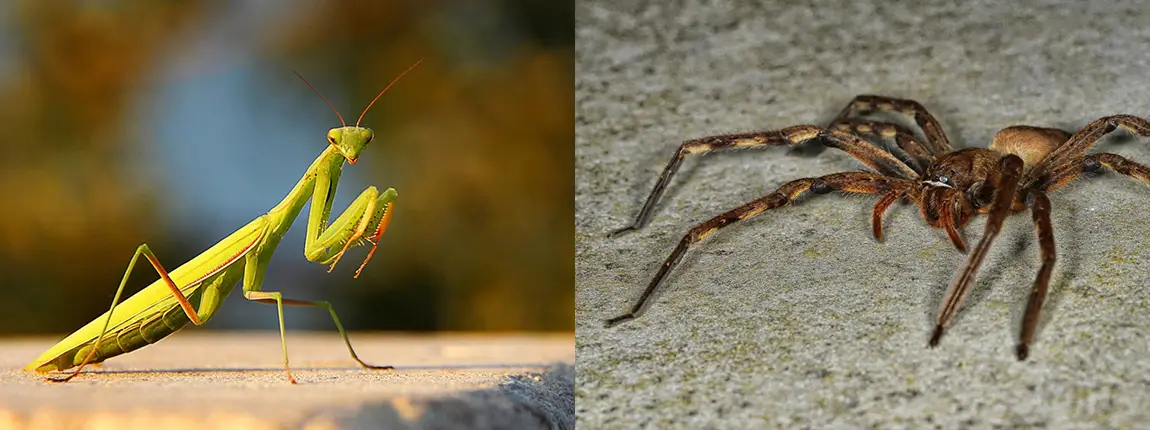
Although some of Africa’s insects are potentially dangerous, there is no need to be scared. If you do not aggravate them, they will not do you any harm.
Frequently Asked Questions
Why is it called a golden orb spider?
The golden orb spider is named after the golden colour of its silk. The colour is thought to attract bees drawn to bright yellow in the sunshine, while blending into the foliage in darkness so that other insects are ensnared.
How big is a golden orb spider’s web?
Golden orb webs can be massive: one has been seen starting at the top of a 6-metre tree and reaching as much as 2 metres across. The genus name, loosely translated from Ancient Greek, means “fond of spinning”.
How big is a common rain spider?
The common rain spider averages about 25 mm in body length, with a leg span of about 110 mm. It is one of the most common spiders in South Africa, found in Mpumalanga, North West, Limpopo, the Eastern Cape and the Western Cape.
What are the three types of honeybee in a hive?
A hive has worker bees, which make up about 99 percent of the colony; drones, the male bees, which usually die straight after mating; and one queen, the colony’s only fertile member, who lays around 1,500 eggs a day in spring and summer.
Why is it called a praying mantis?
The praying mantis is named for its conspicuous front legs, which resemble a human in prayer. It has a long neck and a triangular head that can turn 180 degrees, and it strikes with its spiked forelegs to grasp prey.
Add Kurt Safari as a preferred source on Google (opens in a new tab)
